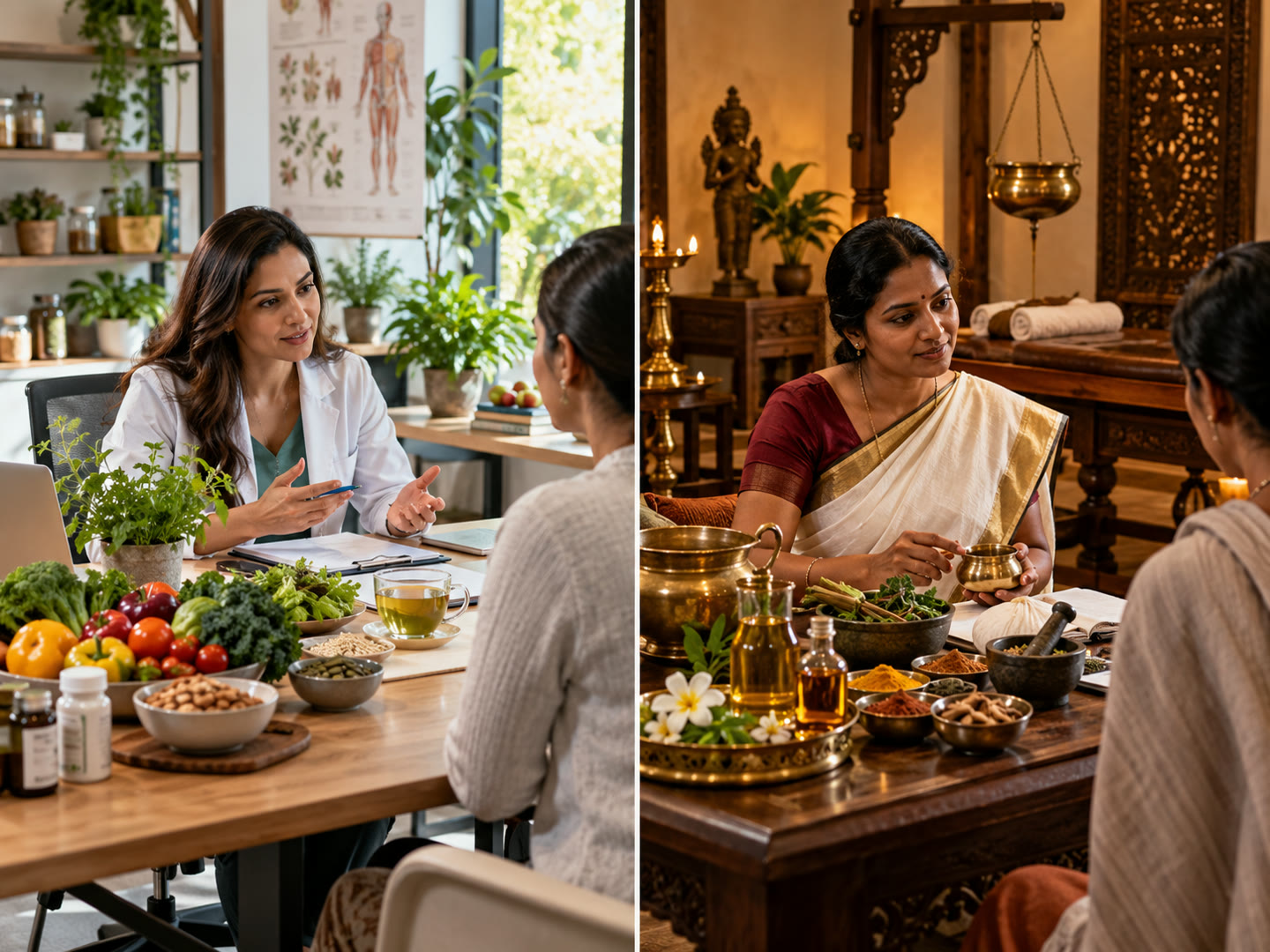
Walk into an Ayurvedic retreat and a naturopathic clinic and, at first, they may not seem very different.
Both practitioners may ask what you eat. How well you sleep. How stressed you are. How your digestion feels. Whether you exercise. What your daily routine looks like.
Both may recommend changes to food, movement, sleep, stress, herbs and lifestyle rather than immediately reaching for medication.
It is easy, therefore, to put Ayurveda and naturopathy into the same bucket: natural, holistic medicine.
But underneath the surface, they are fundamentally different systems.
Ayurveda is an ancient Indian medical system with its own theory of the human body, disease, digestion, constitution and treatment. [1]
Modern naturopathy, by comparison, is a much younger and more eclectic system. It developed largely from European natural-healing traditions in the 19th century and was later codified particularly strongly in North America. Modern naturopathic practice may draw from nutrition, exercise science, botanical medicine, hydrotherapy, physical medicine, supplements, psychology and conventional diagnostic testing. [2]
Their philosophies overlap considerably.
Their medical languages do not.
And that distinction matters.
Ayurveda begins with balance. Naturopathy begins with the body's ability to heal.
Perhaps the easiest way to understand the difference is to ask a simple question:
Why does somebody become unwell?
Ayurveda and naturopathy answer that question differently.
Ayurveda views health through an interconnected model involving concepts such as Vata, Pitta and Kapha, Prakriti, Agni, Dhatus and other physiological principles described in classical Ayurvedic medicine.
One of its central ideas is that people do not all begin from the same baseline.
A person's Prakriti, loosely translated as constitution, describes an individual's characteristic physiological and psychological pattern. Treatment is therefore traditionally individualized rather than based only on the name of a disease.
Two people experiencing what modern medicine calls the same condition might receive different Ayurvedic recommendations because their constitutions, digestive patterns, symptoms, environment and perceived imbalances are different.
That concept of constitution-based personalization remains central to Ayurveda today. At the same time, researchers trying to scientifically standardize Prakriti assessment have found that assessment methods remain variable and can be subjective, which is one of the important challenges the field needs to solve. [3]
Naturopathy starts somewhere slightly different.
Its foundational principle is often described as vis medicatrix naturae, or the healing power of nature: the idea that living systems possess an inherent capacity to maintain and restore health.
The practitioner's role is therefore to identify what might be interfering with that process.
Poor nutrition.
Sedentary behaviour.
Chronic stress.
Disrupted sleep.
Environmental exposures.
Psychological factors.
Underlying disease.
Medication effects.
Metabolic dysfunction.
Or some combination of them.
This leads to other central naturopathic principles: treat the cause, treat the whole person, prevent disease, educate the patient and, where possible, begin with less invasive interventions.
So while Ayurveda often asks:
“What has become imbalanced in this particular person?”
Naturopathy more often asks:
“What is interfering with this person's ability to become healthier?”
The questions sound similar.
The intellectual frameworks behind them are quite different.
Where Ayurveda and naturopathy strongly agree
Despite their very different histories, there are several areas where the two systems meet remarkably well.
1. Health is more than the absence of disease
This may be their strongest philosophical connection.
Neither system traditionally waits for a dramatic disease to appear before paying attention to health.
Sleep matters before insomnia becomes severe.
Diet matters before diabetes develops.
Movement matters before mobility disappears.
Stress matters before burnout becomes overwhelming.
Digestion matters before gastrointestinal problems significantly interfere with life.
This preventative orientation is one reason both systems are particularly attractive today.
Modern healthcare is extraordinarily effective at managing infections, trauma, emergencies and many serious diseases. But much of today's health burden comes from chronic conditions influenced by behaviour, environment, metabolism and lifestyle.
That naturally creates greater interest in healthcare models that ask:
What can we do before somebody becomes seriously sick?
2. Both treat lifestyle as part of medicine
Food is not merely fuel in either system.
Movement is not simply something done to burn calories.
Sleep is not an afterthought.
Stress is not separated completely from physical health.
In naturopathic medicine, lifestyle counselling, clinical nutrition, exercise and stress management are commonly used alongside botanical medicines and other interventions.
Ayurveda similarly places considerable attention on food, daily routine, sleep, activity, digestion, seasonal changes and mental wellbeing.
Modern science increasingly supports many of the broad lifestyle principles that happen to appear in both traditions: regular physical activity, adequate sleep, nutritious diets, stress reduction and healthy social behaviour.
That does not scientifically validate every Ayurvedic or naturopathic theory behind those recommendations.
But it does mean that several practices within the systems overlap with areas of preventive medicine where the evidence is already substantial.
3. Both are inherently personalized
Modern medicine is rapidly moving toward personalized healthcare.
Genetics.
Continuous glucose monitoring.
Wearables.
Pharmacogenomics.
Individual cardiovascular risk.
Microbiome research.
Precision oncology.
Biomarkers.
Instead of asking only, “What disease does this person have?”, healthcare increasingly asks, “What is happening specifically in this person?”
That idea would feel familiar to both Ayurveda and naturopathy.
Ayurveda has practised constitution-based personalization for centuries through concepts such as Prakriti.
Naturopathy individualizes treatment by examining diet, medical history, lifestyle, environment, psychological factors, laboratory findings and other contributors to health.
The interesting opportunity is not to declare that an Ayurvedic dosha is equivalent to a modern biomarker.
It isn't.
The opportunity is to scientifically investigate whether traditional patterns of human variation contain clinically meaningful information that modern tools can measure.
That emerging research area is sometimes called Ayurgenomics, where researchers investigate possible relationships between Ayurvedic phenotypes such as Prakriti and genomic, metabolic or other biological patterns. It is promising as a research direction, but it remains an emerging field rather than established precision medicine. [4]
Where Ayurveda and naturopathy are fundamentally different
This is where the comparison becomes more interesting.
Ayurveda is a medical system. Naturopathy is closer to a medical philosophy plus a toolkit.
Ayurveda has an internally developed framework.
It has theories explaining constitution.
The progression of disease.
Digestion and metabolism.
Diet.
Medicinal plants and formulations.
Daily routines.
Seasonal routines.
Therapeutic procedures.
Clinical assessment.
Whether modern science ultimately validates, modifies or rejects particular concepts, Ayurveda has its own internally coherent medical language.
Naturopathy is much more eclectic.
There is no naturopathic equivalent of Ayurveda's Vata, Pitta and Kapha that organizes the entire medical system.
Instead, naturopathy is united primarily by principles.
Treat the whole person.
Address causes.
Promote prevention.
Support the body's healing processes.
Use the least harmful effective intervention.
But the actual tools used to achieve those objectives can come from many different places.
A naturopath might therefore use nutritional science, botanical medicines, exercise prescription, stress-management techniques, supplements, hydrotherapy or conventional laboratory testing.
Depending on the country and the practitioner's qualifications, naturopathic physicians may also diagnose medical conditions, order diagnostic tests or use treatments that look increasingly similar to conventional integrative medicine. Regulation and scope vary substantially between jurisdictions.
That makes naturopathy more flexible.
It also makes the word naturopathy much less standardized.
Two Ayurvedic physicians may disagree about treatment, but they are generally speaking the same underlying medical language.
Two people calling themselves naturopaths in different countries may have dramatically different education, legal scope and clinical practice.
Their biggest disagreement may be how they describe the human body
This is arguably the point where Ayurveda and modern naturopathy can move furthest apart.
Ayurveda still interprets health through a traditional medical ontology.
Vata, Pitta and Kapha are not conventional anatomical structures or biochemical molecules.
Agni is not simply one digestive enzyme.
Prakriti is not currently equivalent to a person's genome.
These are concepts belonging to the Ayurvedic model of physiology.
Modern naturopathic physicians, particularly those trained in North America, may instead operate largely within conventional anatomy, physiology and pathology.
A patient may therefore be assessed using blood pressure, lipid levels, HbA1c, thyroid hormones, vitamin levels, inflammatory markers or imaging while simultaneously being advised on nutrition, exercise and herbal medicine.
This means naturopathy can sometimes sit closer to modern biomedicine than Ayurveda does.
The philosophical destination may be holistic health.
But the maps being used to reach it are very different.
Another surprising difference: “natural” does not always mean gentle
People commonly imagine both Ayurveda and naturopathy as soft, passive forms of medicine.
Herbal tea.
Yoga.
Massage.
Healthy food.
Rest.
That picture is incomplete.
Ayurveda contains substantial therapeutic traditions including complex herbal preparations and procedures such as Panchakarma. Some traditional formulations may contain minerals or metals, and safety depends heavily on manufacturing standards, practitioner competence, dosing and product quality.
NCCIH notes that some Ayurvedic preparations have been found to contain potentially toxic levels of substances such as lead, mercury or arsenic. [1]
This is an important distinction between traditional and safe.
Something can be traditional without automatically being harmless.
Naturopathy contains similar challenges.
Supplements and herbs can interact with medication.
High doses are not necessarily better doses.
And the quality of naturopathic practice varies enormously depending on training and regulation.
The future of both fields therefore depends less on proving that everything traditional is correct and more on being willing to identify what works, what does not, and what may actually be harmful.
So which one is more scientifically proven?
This is where the conversation requires nuance.
It is difficult to scientifically test an entire medical system as if it were one drug.
Ayurveda includes diet, herbs, behavioural advice, therapeutic procedures, yoga and many other interventions.
Naturopathy might combine nutrition, exercise, counselling, supplements and botanical medicine.
Some individual components have strong scientific evidence.
Others have preliminary evidence.
Some remain poorly studied.
And some traditional claims do not have convincing scientific support.
For Ayurveda specifically, the U.S. National Center for Complementary and Integrative Health notes that some preliminary studies suggest benefits in areas such as osteoarthritis and certain metabolic conditions, but overall the number of high-quality clinical trials remains limited. [1]
Research evaluating whole-system naturopathic care has reported promising outcomes in several chronic conditions, but the literature remains relatively small and researchers themselves have called for larger, better-designed pragmatic trials. [5]
This creates an important distinction:
There is evidence for several practices used within Ayurveda and naturopathy.
That is not the same as saying:
Every theory and treatment within Ayurveda or naturopathy has been scientifically proven.
Good integrative medicine needs to be comfortable holding both statements at the same time.
Where the future of naturopathy may be heading
The strongest future for naturopathy may actually involve becoming less “alternative.”
Its most valuable principles already fit comfortably beside modern preventive medicine.
Nutrition.
Exercise.
Sleep.
Stress.
Behaviour change.
Metabolic health.
Patient education.
Preventive healthcare.
Long consultations.
Understanding the person's environment rather than looking only at a diagnosis.
These are increasingly mainstream ideas.
The opportunity for naturopathy is therefore not necessarily to compete with hospitals.
It may be to occupy the enormous space before and after the hospital.
Helping someone reduce metabolic risk.
Improving lifestyle after a cardiovascular diagnosis.
Supporting healthy ageing.
Managing sleep and stress.
Helping someone build sustainable nutrition and movement habits.
Supporting patients with chronic conditions alongside appropriate medical treatment.
In that future, the naturopath may increasingly work beside physicians, dietitians, psychologists, physiotherapists and health coaches rather than instead of them.
The more naturopathy embraces measurable outcomes and abandons treatments that repeatedly fail scientific testing, the stronger its position becomes.
Ayurveda's future may be even more interesting
Ayurveda has something naturopathy does not:
thousands of years of accumulated clinical tradition combined with an enormous pharmacopeia and a sophisticated personalized-health framework.
But it also has a major scientific challenge.
Much of that knowledge was created long before randomized trials, molecular biology, genomics or modern pharmacology existed.
The next chapter of Ayurveda cannot simply be:
“People have done this for thousands of years, therefore it works.”
Tradition provides a reason to investigate something.
It does not provide the final proof.
The opportunity is enormous precisely because modern science now gives researchers tools that Ayurveda never had.
We can study compounds in traditional plants.
Measure metabolic responses.
Track sleep.
Measure glucose continuously.
Study inflammatory markers.
Analyse microbiomes.
Compare phenotypes.
Run controlled clinical trials.
Use genomics and metabolomics.
Follow thousands of patients over many years.
Even Prakriti can move from an entirely practitioner-dependent assessment toward something researchers can attempt to standardize and test.
Some traditional ideas may survive that process.
Some may be reinterpreted.
Some may turn out to be useful clinically even though the traditional explanation was biologically incorrect.
And some will probably disappear.
That is not the destruction of Ayurveda.
It could be its modernization.
The two systems may eventually converge, but not completely
Interestingly, healthcare itself appears to be moving toward many ideas that Ayurveda and naturopathy have emphasized for a long time.
Prevention rather than only treatment.
Personalization rather than averages.
Mental and physical health considered together.
Lifestyle as part of medicine.
Continuous health monitoring.
Nutrition.
Healthy ageing.
Patient participation.
Long-term wellbeing rather than simply surviving disease.
The World Health Organization's Global Traditional Medicine Strategy 2025–2034 reflects this changing landscape. Its emphasis is not simply on promoting traditional medicine, but on strengthening evidence, improving safety and regulation, integrating appropriate practices into health systems and encouraging research and innovation. [6]
That is probably where both naturopathy and Ayurveda are heading.
Not toward a world where natural medicine replaces modern medicine.
And not toward a world where thousands of years of traditional medical knowledge are simply ignored.
The more interesting future sits somewhere in between.
A person may have their blood work and cardiovascular risk assessed using modern diagnostics.
Their sleep measured using a wearable.
Their nutrition adjusted based on metabolic health.
Their stress addressed through yoga, breathing or meditation.
Their diet considered in the context of culture and digestion.
A traditional botanical preparation might be used, but with known composition, contaminant testing, dosage standards, drug-interaction screening and clinical evidence.
The healthcare system of the future may care less about whether an idea originally came from a laboratory, an Ayurvedic text or a European nature-cure tradition.
It may ask a much simpler question:
Does it safely help this person live a healthier life?
Ayurveda and naturopathy are therefore neither identical nor opposites
They overlap in philosophy:
Look at the whole person. Prevent illness where possible. Take lifestyle seriously. Personalize care. Recognize that health is influenced by more than one organ or one symptom.
But they differ profoundly in how they understand the body.
Ayurveda begins with an ancient Indian model of constitution, balance and physiology.
Naturopathy begins with the healing capacity of the body and uses a flexible collection of interventions to remove obstacles to health.
One is an inherited medical system.
The other is an evolving integrative framework.
And their futures may depend on the same thing:
keeping the parts that withstand scientific scrutiny, improving the parts that can be improved, and being willing to let go of the parts that do not.
That may ultimately create something more useful than either “traditional medicine” or “modern medicine” alone.
It creates healthcare that is at once preventive, personal, holistic and evidence-informed.
This article is educational and is not medical advice. Discuss tests, treatments, herbs and supplements with a qualified healthcare professional. Complementary practices do not replace necessary medical care.