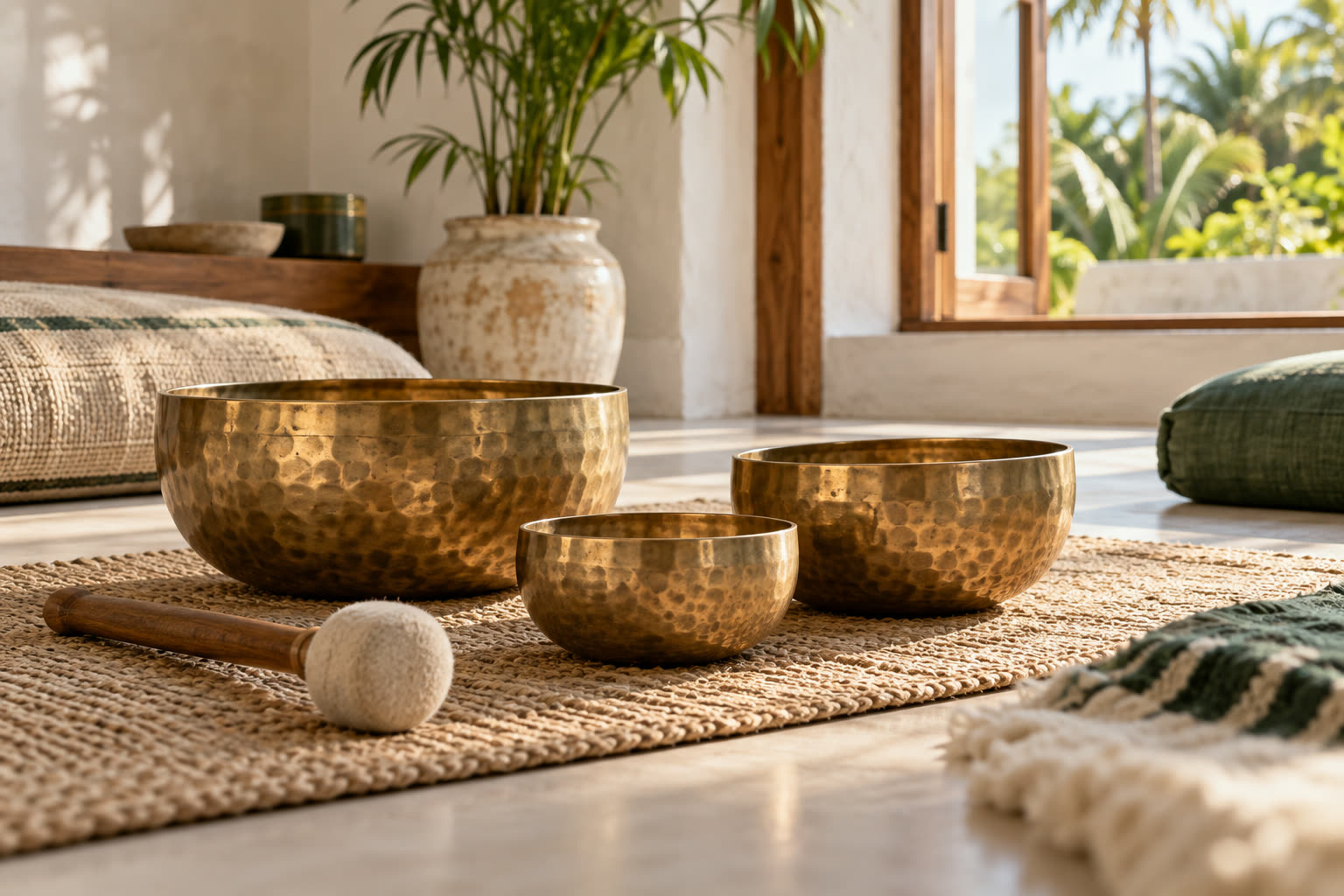
Sound healing is an umbrella term for experiences that use sound as a focus for rest or reflection. A sound bath is one familiar form: you sit or lie comfortably while a facilitator plays instruments such as singing bowls, gongs or chimes. Despite the name, there is no water involved. The invitation is simply to listen.
The word ‘healing’ can suggest more than the evidence supports. A sound bath may feel calming or absorbing, but it should be approached as a wellness experience, not as a treatment for a medical or mental health condition.
What happens at a sound bath?
A facilitator usually introduces the session, then plays a sequence of tones at a measured pace. Some people close their eyes or notice their breathing; others simply follow the changing sounds. Sessions vary in length, volume, instruments and whether they include spoken guidance. You should be able to ask about all of these before you begin, and to sit up, step out or stop if you feel uncomfortable.
There is no correct response. You might feel settled, restless, sleepy or unexpectedly emotional. A session does not need to produce a particular sensation to be worthwhile, and an intense reaction is not evidence that something has been ‘released’.
What does the research say?
Studies of singing bowls have reported promising short-term changes in measures such as anxiety and mood. But the studies differ in how sessions are delivered, many are small, and longer-term effects are unclear. A 2025 systematic review described potential benefits while calling for stronger controlled studies. That is a reason to stay curious, not to promise a result.
Research on music-based interventions is broader, but it cannot be applied wholesale to sound baths. The US National Center for Complementary and Integrative Health notes that many music studies are preliminary and that music therapy refers to work delivered by a trained therapist within a therapeutic relationship. A group sound bath is not automatically music therapy.
Choosing a session with care
Ask who leads it, how loud it will be, whether the room is accessible and what you can do if you prefer to leave. Loud sound can be uncomfortable or harmful; people with sound sensitivity, tinnitus or a history of distressing responses to particular sounds may want to discuss their needs with the facilitator first. If you are seeking help for a health concern, speak to an appropriately qualified professional rather than relying on a sound bath.
Where it belongs in a journey
The appeal of a sound bath is its simplicity: a little time set aside without a task to complete. It can sit alongside other ways of slowing down, from a walk to a quiet morning. At The Leisure Health, we distinguish experiences that support a pleasant pause from clinical care. Sound baths are not a confirmed inclusion in our journeys; any proposed session, facilitator and setting would be identified in the written itinerary.
Practical questions
Questions travellers ask
What is the difference between sound healing and a sound bath?
Sound healing is a broad label for sound-led wellness practices. A sound bath is a session in which a facilitator plays instruments while participants listen, usually seated or lying down.
Is a sound bath the same as music therapy?
No. Music therapy is a health profession delivered by a trained therapist in a therapeutic relationship. A sound bath is not automatically a clinical service.
Can sound healing treat anxiety or another health condition?
Current singing-bowl research is not strong enough to promise treatment effects. A sound bath may be an enjoyable complementary experience, but it does not replace appropriate medical or mental health care.